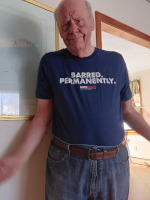
Bret Stephens, the token sensible columnist at the NYT, presents The Literary World’s D.E.I. Checklist. (NYT gifted link)
Last week, the longlists for the National Book Awards were announced. Among the 20 authors in the fiction and nonfiction categories, nearly all are straight white males. Most are also on the political right, some even on the far right. Remarkably, mainstream media outlets haven’t reported this, perhaps because they don’t think it’s noteworthy. It’s as if we were living in 1956 rather than 2026.
If you’re scratching your head at this “news,” well, it’s because I made it up. Or rather, I inverted the particulars about the authors’ identities and their political views to make a point: If today, as a reader, you recoil at the thought of a time in which minorities were systematically marginalized when it came to the literary world’s public honors (and so much else), shouldn’t you also recoil now that the tables have been almost completely turned? And if you object to the right’s efforts to politicize the arts, won’t you also object when the efforts come from the left?
For a sense of what I mean, let’s walk through the National Book Foundation’s announcement of the longlist for fiction, 10 books selected out of 451 titles submitted by publishers.
Hannah Lillith Assadi’s novel, “Paradiso 17,” is “inspired by the life of her late Palestinian father.” Kimberly Blaeser, a poet, is the “founding director of Indigenous Nations Poets.” Edwidge Danticat is a Haitian American writer whose novel “Dèy” reflects on “the many forms of mourning experienced through immigration, gentrification and diasporic identity.” Julián Delgado Lopera’s novel “Pretend You’re Dead and I Carry You,” set in 1990s Bogotá, “explores Colombia’s queer underground community.” Louise Erdrich, the highly acclaimed author of “Python’s Kiss,” is identified in her N.B.F. biography as “a member of the Turtle Mountain Band of Chippewa.” Marlon James’s novel “The Disappearers” is a “queer epic” set in Kingston, Jamaica. Valeria Luiselli is a writer born in Mexico whose “Beginning Middle End” spans “continents, languages and four generations.” Kenan Orhan is a Turkish American writer; his first novel, “The Renovation,” is a story about a family migrating from Istanbul to Italy. Morgan Thomas’s book “Mad Eden” is about “a trans health care worker” who has been diagnosed with autism.
Bret has more examples of what passes for "diversity, equity, and inclusion" in the rooms where nominations and awards are bestowed in the book game. If you're a heterosexual white guy looking to break in as an author, you'd be well advised to have a solid backup plan.
Also of note:
-
The old normal wasn't great, but… At Reason, Jacob Sullum describes How Murdering Suspected Drug Smugglers Became the New Normal .
President Donald Trump was excited about a new military operation. "Earlier this morning," he announced on the afternoon of September 2, 2025, "U.S. Military Forces conducted a kinetic strike against positively identified Tren de Aragua Narcoterrorists in the SOUTHCOM area of responsibility." That attack should "serve as notice to anybody even thinking about bringing drugs into the United States of America," he said. "BEWARE! Thank you for your attention to this matter!!!!!!!!!!!"
Those 11 exclamation points might have seemed like overkill. But Trump was right that Americans should have been paying attention. His Truth Social post, which included a 29-second video clip showing a speedboat in the Caribbean Sea exploded by a missile, marked a radical and alarming shift in U.S. drug policy.
In case you're wondering what the current body count is, Jacob provides a link to the current scoreboard maintained by the NYT. As I type: 70 strikes, 234 people killed. Jacob comments further:
With a few exceptions, we do not know who those people were, let alone what evidence the government might have had to implicate them in drug trafficking. But Trump assures us they were all "narcoterrorists" who richly deserved their fate, even though they would not have faced the death penalty under U.S. law and, judging from what happened to drug smugglers arrested around the same time, probably would not have been prosecuted at all if they had been lucky enough to be caught by the Coast Guard.
I assume the dirtbag percentage among those 234 individuals was high. Still, it's not something we should be proud of.
-
Deirdre McCloskey has market advice. Unfortunately, not of the "hot stock tip" variety, just a general suggestion: Let It Work. Despite the massive numbers of nay-sayers and quibblers decrying "market failures" and saying nasty things about "market fundamentalists"…
Well, why do I, after 84 years on this planet (on September 11, thanks), most of it spent thinking about the evidence on how economies work, disagree with the numerous non-believers?
For one thing, as a resident of an economy, I live daily inside a massive experiment proving that it does work pretty much as supply and demand says. So do you live inside it. São Paulo is an enormous city. It exhausts me to drive across it. Yet somehow every day when you go to get a morning coffee, there it is. When you want to buy a new shirt, there it is. If you had the misfortune to live in a country that so strongly denies market forces that it makes them illegal, such as North Korea or the old Soviet Union, this would not be the case. The Soviets made endless jokes about it not being the case.
For another, as an economic historian, I know, and can show you massive evidence, that liberated people become amazingly creative and then make themselves and everyone else amazingly rich. It has happened from 1776 to the present, I’ve told you frequently, to the extent of 25 thousand percent, for the first time in history. In a century or so, if the economists and politicians don’t intervene, everyone will be twice as rich as the average Swiss person now. I mean Africa. I mean everywhere.
For another, as an economist of a mathematical and philosophical bent, I have a vision of the economy as an enormous spontaneous order, like the Portuguese language or the history of art or even the pattern of your own sweet life.
It’s lovely. Let it work.
I hope I'm as sharp as Deirdre if and when I make it to 84.
-
Well, it's not as if he had any choice in the matter. Jerry Coyne takes on another believer in free will: Rob Henderson completely messes up when discussing free will.
You can read Henderson's
messed uparticle in his newsletter here: Apparently Criminals Don’t Have Free Will, But Elites Do. It was originally published at the WSJ's "Free Expression" newsletter back in May, and I blogged about it (and partially disagreed with it) back then.What's Jerry's gripe? Well, the usual, and it's kind of rough:
Apparently one of Henderson’s “luxury beliefs” is belief in free will, as you can tell from the title of his Substack post below. But his thesis is not only wrong, but a dog’s breakfast of a meal. For one thing, he never defines free will. And he makes a ton of statements about it that are simply full of holes. I could write a substantive essay about how Henderson’s short piece is misguided, but it doesn’t deserve that. So what I’ll do is put his statements in bold, indented type, and put my responses in plain text flush left. Truly, I don’t understand why this guy doesn’t understand.
Let me start by saying that, as always, I conceive of free will as “contracausal” or “I could have done otherwise” free will, explained as the ability of a person in a given situation, with all the molecules of the universe poised at the moment of decision/action, to have done more than one thing. It does appear that Henderson has that notion, too, but he doesn’t say so.
Well, let's assume he didn't think he needed to. Jerry conflates two different things, "decision" and "action", and places them in the same "moment". But clearly the "decision" precedes the "action." Maybe by milliseconds, maybe longer. In some cases, the decision process can take far longer than a "moment".
Jerry's right that at the "action" moment, it's too late to change. By definition it happened just then, at t=0.
But the "decision"? Nah. And that's where "free will" comes in.
No, I don't know how it works, at the level of synapses and neurochemistry. But I think it does.
| Recently on the book blog: |


|