Need a Smile on Your Face Today?

This should do the trick:

It's old, I had seen it before. But it's really timeless. And amazingly well-done.

But if you need additional cheering up…

Perhaps you noticed the grim story out of the Harvard T.H. Chan School of Public Health a few months back: Proximity to nuclear power plants associated with increased cancer mortality. Uh oh.

U.S. counties located closer to operational nuclear power plants (NPPs) have higher rates of cancer mortality than those located farther away, according to a new study led by Harvard T.H. Chan School of Public Health.

The study is the first of the 21st century to analyze proximity to NPPs and cancer mortality across all NPPs and every U.S. county. The researchers emphasized that the findings are not enough to establish causality but do highlight the need for further research into nuclear power’s health impacts.

To repeat: Uh oh!

The HTHCSoPH story refers to the concurrent publication in Nature Communications: "National analysis of cancer mortality and proximity to nuclear power plants in the United States." Prestigious! Here's the abstract:

Understanding the potential health implications of living near nuclear power plants is important given the renewed interest in nuclear energy as a low-carbon power source. Here we show that U.S. counties located closer to operational nuclear power plants have higher cancer mortality rates than those farther away. Using nationwide mortality data from 2000-2018, we assess long-term spatial patterns of cancer mortality in relation to proximity to nuclear facilities while accounting for socioeconomic, demographic, behavioral, environmental, and healthcare factors. Cancer mortality is higher across multiple age groups in both males and females, with the strongest associations among older adults, males aged 65–74 and females aged 55–64. While our findings cannot establish causality, they highlight the need for further research into potential exposure pathways, latency effects, and cancer-specific risks, emphasizing the importance of addressing these potentially substantial but overlooked risks to public health.

Wow, they used a lot of controls. Sounds like science!

But you might want to read those articles quickly before they are memory-holed. Because:

Pun Salad readers may have noted my occasional references to the University Near Here. As it turns out, "statistics show" that living in proximity to a public college is associated with 626,212 cancer deaths.

Aieee! I'd be safer if I moved down to Seabrook!

You can read Adam Stein's twitter thread, or you can read his and Deric Tilson's article at the Ecomodernist: Things that Apparently Cause Cancer. Excerpt:

It would shock you to know that Costco, according to a new Harvard School of Public Health methodology, caused 120,687 cases of cancer mortality nationally every year, simply due to living in close proximity to their warehouses. Private colleges accounted for 83,782 more. Harvard itself is responsible for 5,842 cancer deaths. Living near a Major League Baseball field causes almost 19 times as many cancer deaths as living near a Major League Soccer pitch. These conclusions are obviously absurd, but they come from the exact same methodology that researchers at Harvard use to “prove” that nuclear power plants cause cancer in nearby communities.

Earlier this year, Adam Stein and I called out a series of Harvard studies showing that nuclear power plants were associated with higher rates of cancer incidence and cancer mortality as nonsense. Now that we’ve spent the last few months replicating the analysis and expanding it, we are able to show that no matter what landmark you use, their methodology will show an increased cancer risk and mortality. The studies simply do not prove anything about cancer incidence.

What follows is a brutal takedown of the Harvard study. Reader, you may get cancer (it happens), but it will not be because you lived too close to a Costco.
Channel Your Inner Physics Geek

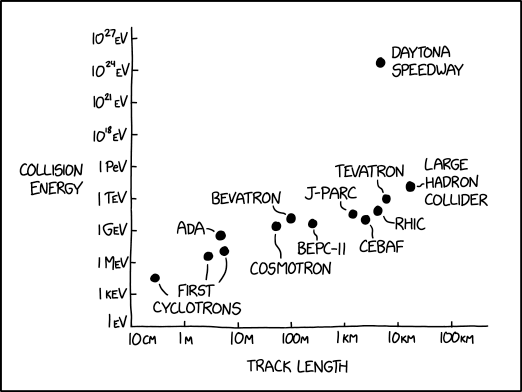
With this recent xkcd cartoon: Accelerator Energies:

[Accelerator Energies]

And there's a good mouseover: "Fans at Daytona always get extra excited when officials decide to introduce some antimatter cars circling the track in the opposite direction."

Also of note:

  • Who is Zohran Mamdani? His definition of "socialism" has people chattering (and I am apparently no exception). For example:

    Continues:

    […] breath. Housing, childcare, public transit. No one should be priced out of these things. These are non-negotiables, you need these to live”

    If your eyes haven't rolled completely out of your head yet, I'll make the first, obvious, point: when Mamdani says "it is the government's job", what that boils down to is that it's the taxpayer's job. The government simply facilitates the coerced transfer of funds, after skimming a hefty share off the top for its employees.

    While expecting everyone to be grateful for its service.

    Coincidentally, I noticed philosopher Michael Huemer making a related point, exactly five years ago. Michael's original post is now behind some kind of anti-bot software with which I declined to cooperate, but here's an excerpt from my original excerpt:

    The [socialist] system rewards those who are behaving badly according to the values of the socialists themselves, and punishes those who are behaving rightly according to those same values. That is the core problem that [Ayn] Rand saw with socialism.

    That is partly a consequentialist problem, and partly a problem of justice: One cannot hope to promote some set of values by punishing anyone who acts according to those values and rewarding the opposite behavior. That is just not going to work out. It’s also obviously, paradigmatically unjust, if you think those are the correct values.

    Michael linked to a lengthy excerpt from Atlas Shrugged, a soliloquy from an ex-employee of The Twentieth Century Motor Company, where he describes the firm's quick slide into the void after democratic approval of a plan that "everybody in the factory would work according to his ability, but would be paid according to his need." A key paragraph:

    “Well, we got what we asked for. By the time we saw what it was that we’d asked for, it was too late. We were trapped, with no place to go. The best men among us left the factory in the first week of the plan. We lost our best engineers, superintendents, foremen and highest-skilled workers. A man of self-respect doesn’t turn into a milch cow for anybody. Some able fellows tried to stick it out, but they couldn’t take it for long. We kept losing our men, they kept escaping from the factory like from a pesthole—till we had nothing left except the men of need, but none of the men of ability.

    I've previously plugged "Francisco's Money Speech" from Atlas Shrugged. This one is longer, and almost as good.

  • But I thought we were supposed to "stand on the shoulders of giants." Robert Graboyes headlines the lyrics to an old Tom Lehrer song, relevant to our AI era: Plagiarize! Plagiarize! Plagiarize! Only Be Sure Always to Call It, Please, “Research.”.

    Artificial intelligence (AI) and the internet scramble age-old definitions of and ethical rules surrounding authorship, intellectual property, and plagiarism. As in the previous Bastiat’s Window column (“AI, Internet, and Rapid Advances in the Technology of Fraud”), this post was inspired in part by Jorge Luis Borges’s 1940 short story, “Tlön, Uqbar, Orbis Tertius,” a quote from which appears in the graphic atop this piece. The title of today’s essay is cheerfully stolen from songwriter/satirist Tom Lehrer, who cheerfully stole from others and urged others to steal from him.

    Does a large percentage of output from and usage of AI platforms (e.g., ChatGPT, Grok, Claude) constitute plagiarism—and if so, is it feasible to define, detect, and prohibit what has long been considered intellectual property theft? Large-language-model (LLM) AI platforms scamper about the internet, gathering authors’ writings, and reconfiguring those borrowings into new documents for users. This raises two questions:

    • Do they lift whole paragraphs or pages from existing texts and paraphrase them to evade plagiarism detectors? This would constitute paraphrase plagiarism.

    • Are AI users presenting AI output as their own original work? This would constitute AI plagiarism—a problem so new that there’s no agreed-upon term or ethical standard governing its usage.

    Robert makes interesting and subtle points, and uses ChatGPT to plagiarize Barry Goldwater's 1964 acceptance speech. Plus, plus, plus.

  • Not even getting the basics right. Kevin D. Williamson takes on the latest capital punishment scandal: Tennessee Poison. (Dispatch gifted link)

    Assessing the conditions in Reading Gaol, Oscar Wilde remarked: “If this is the way Queen Victoria treats her convicts, she doesn’t deserve to have any.” I wonder whether We the People of the United States deserve to have any convicts at all, or condemned men—or condemned women.

    The story of Christa Pike, whom Tennessee officials have—so far—twice tried to poison to death, would be the blackest of black comedy if there were any comedy in it. Tennessee Gov. Bill Lee, being a Republican in 2026, is funny only unintentionally, saying of the twice-botched execution of his state’s only condemned female murderer: “Tennesseans deserve a justice system that is fair, that’s consistent, that is faithfully administered. My responsibility is to uphold the sentences that Tennessee juries have handed down, even when it’s difficult, and that is exactly what we intend to do in the days ahead.” If words mean anything, then the governor’s words would seem to mean that his state intends to try to kill her again in the interest of consistency and faithful administration and responsibility. I am tempted here to take the Lord’s name in vain.

    KDW's bottom line, with which it is difficult to disagree: "If Tennessee is going to wield the power of life and death in this slapstick fashion, then Tennessee does not deserve to have it."


Last Modified 2026-10-04 8:25 AM EDT

Sing Along With the AIs

Or Read Alan Jacobs

Via Alex Tabarrok at Marginal Revolution: a debate over an essay by Arvind Narayanan & Sayash Kapoor: AI as Normal Technology. Lede:

We articulate a vision of artificial intelligence (AI) as normal technology. To view AI as normal is not to understate its impact—even transformative, general-purpose technologies such as electricity and the internet are “normal” in our conception. But it is in contrast to both utopian and dystopian visions of the future of AI which have a common tendency to treat it akin to a separate species, a highly autonomous, potentially superintelligent entity.

Well, that's (kind of) a relief. But it sponsored a lively debate. In a YouTube rap battle!

(Actually, I don't know if "rap battle" the proper nomenclature. I'm not young. But both sides include very catchy tunes.)

Up first, a rebuttal to Narayanan and Kapoor:

Which brought a tweeted response from Kapoor:

Both created "almost entirely" by AI.

Don't ask me who wins here, both sides seem pretty smart. I'll just put Fleetwood Mac's "Don't Stop (Thinking About Tomorrow)" on an iPod loop. And maybe read Alan Jacobs, who (I think) has a relevant point as well: This Changes Nothing.

That world-transforming, world-shattering, world-saving technology/person/event? The one that “changes everything”? It changes nothing. You're still you, and the same challenges confront you that have always confronted humanity and will always confront humanity. Every week you give yourself a new reason why you now don't have to think about loving your neighbor as yourself, turning the other cheek, doing justly and loving mercy and walking humbly with your God. It’s a crisis! It’s Flight 93! But come on: you're kidding yourself. Everything important is what it was, and wherever you go, there you are. Hey, I get it: All you want is to get off Mr. Bones’ Wild Ride. But it ain't happening. The ride never ends ... until you do. 

Let me add a bit of wisdom that Ike never actually said: "Things are more like they are today than they have ever been before."

Also of note:

  • It's not euphemism, it's meephemism. I recently subscribed to John McWhorter's NYT column, and it's all good, man, and I especially liked this one from July: Euphemism Won’t Save Young Black Men’s Lives. (NYT gifted link)

    The Fourth of July weekend was “marked by dozens of U.S. deaths from gun violence,” according to The Guardian. A few weekends ago, there were 27 shootings in Chicago, with eight fatalities. This set folks scratching their chins about “gun violence prevention.”

    The term is now so common it’s easy to miss how strained it is. “Gun violence” sounds as if guns are committing the violence. The expression artfully excises from the equation the actual person doing this “violence” — the shooter. This passive construction evades the fact of someone’s pointing a weapon and pulling a trigger and sending a bullet into a person’s flesh and bone. It turns shootings into abstract formless phenomena, like gravity or ultraviolet light. Note in contrast that we never talk about “knife violence” when someone uses a knife to attack others, we just call these assaults stabbings.

    The term became much more common in the 1990s, as the horrifying wave of murders and woundings and terror in poor Black neighborhoods began to be seen as a public health issue.

    A commenter notes that the obfuscation runs even deeper: the "gun violence" statistics lump in gun suicides with the homicides. Inflating the "public health" issue, pointing the blame at the gun.

  • Irony can be … pretty ironic sometimes. Daniel J. Flynn welcomes an annual celebration, and observes: Censorship Prevails Among Those Who Decry Censorship. (NR gifted link)

    Banned Books Week, which begins this Sunday, ironically presents to the public a more monolithic face than the modern-day Anthony Comstocks it purports to counteract.

    The four chairs of Banned Books Week include anti–Second Amendment activist Bess Kalb, who has written comedy for Jimmy Kimmel and Hillary Clinton; Marshall Romero, a self-described “transgender teenager with aspirations in politics”; and Azeemah Sadiq, whose bio lists her interests as “fighting for equity in underserved communities” and “electoral justice.” Given the heavy-handed DEI book displays one inevitably encounters at all times in any big-city library (a trip to my local library this week revealed three consecutive tables that highlight books by feminists, gays, and immigrants, respectively), the notion pushed by the American Library Association and other allied groups that libraries, schools, and other institutions overwhelmingly populated by left-wing employees do not themselves censor politically incorrect books but instead succumb to pressure by intolerant, external forces on the right seems rich.

    Let me (again) point out a pretty good book I recently read about censorship carried out in the name of DEI: That Book is Dangerous! by (self-admitted socialist) Adam Szetela. Which, good for them, I got at the Portsmouth (NH) Public Library. I wonder if they'll put it in their Banned Books Week display?

  • And as usual: Nellie Bowles' TGIF column, this week headlined: No Fatties, No Beardos, No Weirdos. A long-but-worth-it excerpt:

    → AI summit delivers some great body language: All the Big Tech leaders came together with President Donald J. Trump to sign a “morally binding” pact that they won’t build artificial intelligence that kills us all. I love that. Morally binding. Call it what it is: a pinky swear for boys. I feel as though morally binding is another term for not legally binding, if you get me. It’s like if someone says they’re “morally monogamous” in this marriage, so I immediately understand they are cheating on each other. Here’s the president: “The biggest people in the world signed that and I signed it as president. And it really is a form of protection.” And: “I’m seeing tremendous self-policing.” Again: Self-policing means absolutely no policing. This meeting of kings was organized by House Speaker Mike Johnson. Now, on the one hand, morally binding and self-policing are both completely fake things that mean utterly nothing. Morally binding to whom? Trump? Morally binding. . . to Trump. At best, that means nothing. At worst, it means our tech leaders are about to collectively get a new set of younger, hotter wives. On the other hand, do I actually want the government regulating AI? The man who gathered everyone together for this high-tech summit of the future, Speaker Mike Johnson, literally doesn’t believe in evolution. Sorry, he believes in morally binding evolution. Intelligent self-design, if you get my drift. I’m not faulting the speaker for that, per se; I’m just suggesting that perhaps our government bodies are not the best group to decide complex regulations for developing technologies. Maybe it’d be better if AI regulated our government. Just an idea. It already made such a good website for us. I think AI would make a nice president. Cold, direct, and yet sycophantic. Take my vote!

    The best part of the summit was watching Anthropic CEO Dario Amodei trying to act normal. At some point he gave a brief statement and then when someone in the press asked a question, he got so flustered that he started stimming, excused himself from the dance circle, then turned to hide behind someone (anyone), and it’s all so awkward that everyone around him tried not to laugh. Poor Dario. He wanted to make the computer do tricks and talk about rationalism on a bean bag chair and now there’s a CNN reporter screaming at him about data center water usage. Someone get this man his fidget spinner and give him back his over-the-ear headphones.

    As part of the summit, Trump rebranded artificial intelligence to “super intelligence.” And I guess this encouraged everyone to get .si domain names. Trumpo has so many corruption schemes that at this point I’m very open to new, baseless corruption conspiracies, and here’s one: Maybe Trump told insiders about his “super intelligence” rebrand early because before anyone announced anything, a lot of people scooped up all the good .si domain names. It’s lucrative stuff. For example, Build.si seems to be for sale for $10 million. That’s a nice, tidy sum. Also, if you didn’t think artificial intelligence versus super intelligence would become a new culture war issue, think again, my homies!

    Uh, thank you? But is this what America is asking for? Is this the new Gulf of Mexico versus Gulf of America? Artificial, super, I don’t really care. Just as long as it tells me I’m right.

    … and also compliments me on asking insightful and important questions. Like Claude does.

Embrace the Power of "And"

Mr. Ramirez seems a tad irritated:

That's his commentary on this: America Will Never Be a Communist Country.

And if you missed the initial brouhaha about the ad, the WSJ article from a few days ago will clarify: U.S. Government Airs Pro-Trump, Anti-Communism Ad. (WSJ gifted link)

On Wednesday night [September 23], a local CBS News reporter in Miami noticed something unusual during a Fox News commercial break: a punchy pro-Trump ad that said it was paid for by the U.S. government.

The ad begins with President Trump saying a frequent line he uses on the campaign trail: “Together we will defeat communism, Marxism in America once and for all.” The ad follows with dozens of images of the president at White House events. Playing in the background is a choir singing “Love Me.” Trump ends by saying “America will never be a communist country” and in small letters at the bottom of the screen it reads, “Paid for by the U.S. government.”

Creepy? Offensive? Out of the pages of 1984? See today's headline: it can be all those things. Not to mention "illegal". The WSJ story continues:

The administration’s decision to fund an advertisement that appears to include a voice clip from the Republican National Convention could violate federal law, ethics experts said.

“This is an astonishing misuse of public resources in the campaign context, one of the most blatant I’ve ever seen,” said Daniel Weiner, a former campaign finance official and senior director at the Brennan Center for Justice, which has been critical of Trump on ethics issues.

Unfortunately, anyone in a position to make the call on law violation is firmly in Trump's pocket. For example, FCC Chair Brendan Carr is more interested in going after journalists.

Coincidentally, via Patterico's Pontifications:

So we're kinda getting a mixed message from the Executive Branch about Commies.

Also of note:

  • "Look, Dave, I can see you're really upset about this." Sorry, that's what sprung to my mind while reading Anil Seth's essay, The Mythology Of Conscious AI. He's pretty convincing that "intelligence" is, at bottom, a tool for doing stuff. While "consciousness" is a different kettle of fish:

    The propensity to bundle intelligence and consciousness together can be traced to three baked-in psychological biases.

    The first is anthropocentrism. This is the tendency to see things through the lens of being human: to take the human example as definitional, rather than as one example of how different properties might come together.

    The second is human exceptionalism: our unfortunate habit of putting the human species at the top of every pile, and sometimes in a different pile altogether (perhaps closer to angels and Gods than to other animals, as in the medieval Scala naturae). And the third is anthropomorphism. This is the tendency to project humanlike qualities onto nonhuman things based on what may be only superficial similarities.

    I may be wrong, but I think of consciousness (and its cousin, free will) as "emergent properties": functionality that develops (via evolution, for you God-evaders) out of interactions of sufficiently complex nervous systems that are not themselves conscious.

    And I've recently thought there's nothing to stop a sufficiently complex computing system from developing the same way.

    But (on the other hand) there may not be any reason to expect that a computing system's "emergent properties" would look anything like human consciousness. We humans might not even be able to recognize it, let alone predict its behavior.

    Well, sorry, that's for you college sophomores to discuss in your dorm rooms.

  • Free Luigi (with the purchase of another Luigi of equal or greater value). Jonathan Turley notes some disturbing attitudes down at Harvard Med School. “Free Luigi”: Rutgers Professor Calls for the Liberation of Accused Murderer Mangione.

    Roxane Gay is the Gloria Steinem Endowed Chair in Media, Culture, and Feminist Studies at Rutgers University–New Brunswick. She currently serves as the artist-in-residence at Harvard Medical School and called this week for the “liberation” of accused assassin Luigi Mangione. Gay (the cousin of former Harvard University President Claudine Gay) is the latest example of the radical chic of higher education.

    Professor Gay was on a panel on “fat liberation” at Harvard Medical School. In a video posted to X, Gay responds to a question about the health industry by declaring “Free Luigi, for one.” She added that “The health insurance industry is equal opportunity evil. They are terrible for thin people, for fat people, for white people, for black people … They just want to prioritize profit over bodies and health.”

    It appears that it is not evil to murder UnitedHealthcare CEO Brian Thompson in December 2024, leaving a widow and children without a husband and father

    Roxane was one of the prime panic-inducers cited by author Adam Szetela in his book That Book Is Dangerous!: How Moral Panic, Social Media, and the Culture Wars Are Remaking Publishing, which I reported on over at the book blog a few days ago. She's an enthusiastic culture warrior, apparently much tougher on authors that offend her than she is on cold-blooded murderers.

  • Also college administrators. Jeffrey A. Singer discusses some nanny-statism: Smoking Is Bad for You. Nicotine Isn't—but Politicians Keep Trying To Ban It.

    Easthampton just became the 25th Massachusetts municipality to adopt a "nicotine-free generation" policy. Anyone born after January 1, 2006, will never be old enough to legally buy nicotine products there. The ban doesn't just apply to cigarettes. It also applies to noncombustible nicotine products that can help smokers reduce their risk.

    Decades of anti-smoking campaigns have dramatically reduced cigarette use, especially among young people. That's great news. But somehow along the way nicotine itself became associated with the worst harms of smoking, even though the chemical is not responsible for the cancers, the lung disease, or most of the cardiovascular disease caused by combustible tobacco. Worse, the pendulum has swung so far in the maximalist anti-nicotine direction that we risk criminalizing some of the most effective smoking-cessation alternatives.

    As we've previously discussed, the University Near Here tossed nicotine in with tobacco products in its draconian prohibition policy. Read Jeffrey's article to find out how that's pointless and (worse) counterproductive.

According to Google, It Rhymes With "Jonah Rides"

[Amazon Link]
(paid link)

Katherine Mangu-Ward makes The case for good faith.

I've never been sure how to pronounce it. Bo-nah feed-ays? Bah-nah fieds? The term bona fides trips me up every time. But it's an important concept, so I try my best. You might even say I make…a good faith effort.

To argue in good faith—the literal translation of the Latin—means assuming that the person on the other side is saying what he actually believes and that disagreement is not itself evidence of corruption, cowardice, or deceit. And vice versa.

The assumption and practice of good faith makes intellectual debate possible. And yet it feels increasingly rare.

Katherine's Exhibit A is J.D. Vance, whose announced views on Trump and economics pirouetted just when he felt he needed to be elected.

Also of note:

  • A bad idea. And it's being pushed by my state's outgoing US Senator:

    Translation: she wants American taxpayers to pay for baby-killing. What a ghoul.

  • Another bad idea. And it's being pushed by a "bipartisan" array of CongressCritters: Federal Film Tax Credit Would Push Industry's Labor Costs on All Americans.

    Hollywood has been in decline for years as studios cut spending and shift production overseas. Now the companies and unions that run the town are seeking a bailout from federal taxpayers in the form of a costly “incentive,” and their friends in Congress are happy to oblige.

    Last week, lawmakers released the Motion Picture, Television, and Entertainment Revitalization Act — a gilded name for an open-ended subsidy to the film industry. The bill would create a federal tax credit for movies and television shows produced predominantly in the United States, covering 20 percent of nearly all their labor costs. Bonuses for special conditions could raise a project’s subsidy rate up to 30 percent. One such bonus is for filming in declared disaster areas, which — because of last year’s wildfires — includes all of Los Angeles County until 2030.

    The NR editorialists note the irony of many Democrat pols who usually decry "trickle-down economics" supporting this, where the whole theory is that the tax credits will generate benefits (for, say, Tom Cruise) that will shower down on the nearby plebians (say, Tom Cruise's Ferrari dealer).

    But at least it doesn't kill babies.

  • There are no "controlled substances"; there are only controlled citizens. Thomas Szasz said (something like) that long ago. But as Jacob Sullum notes, it's a problem: Hazy Federal Criteria for Classifying Drugs Invite Arbitrary Bureaucratic Judgments: A GAO Report Notes That the Controlled Substances Act Does Not Define 'Potential for Abuse' or 'Accepted Medical Use'

    Half a century ago, Congress approved the Controlled Substances Act, which established a system for classifying drugs based on their "medical use" and "potential for abuse." But as a recent report from the Government Accountability Office notes, the statute does not clearly define either criterion, opening the door to debatable and changeable regulatory judgments with far-reaching criminal justice implications.

    Jacob details the vagueness and (therefor) inherent arbitrariness this implies. And, of course, it's all fun and games until it's time to start sending people to jail. Bottom line:

    The GAO thinks the FDA should specify "the criteria and process for determining a substance's 'potential for abuse.'" The lack of clarity highlighted by the report is astonishing, given how long Americans have been living with the CSA, which criminalizes a wide range of peaceful conduct and prescribes penalties based on arbitrary bureaucratic distinctions.

  • You could just ignore them and hope for the best. Whatever. Look at Kevin D. Williamson's article as a likely prediction and good advice: How to Think About Impeachment No. 3—and the One After That. (Dispatch gifted link)

    The Democrats are sitting on a clutch of very promising-looking political eggs, but they won’t be hatched until the first Tuesday in November. You never know about chickens, but the widely held consensus is that the Republican majority in the House is fixing to be as dead as the fried ones over at KFC, and more than a few observers are betting on a Senate flip, too.

    It is of some interest that Republican dogs are not barking much about impeachment. Donald Trump’s foundering popularity is such that Republicans rat-paddling away from the sinking ship of his administration evidently have calculated that there is not a lot of cheese to be got from squeaking about the threat of a third impeachment. Rep. Jim Jordan, who is only the second most detestable Republican from Ohio on the political scene, complained last week that Democrats would conduct a campaign of “nonstop weaponized investigations” once in the majority. Coming from a Trump loyalist, that is a little like hearing the ghost of Sonny Barger complaining that a few of the mourners didn’t wear ties to his funeral.

    Mostly, Republicans are not talking much about the possibility of another Trump impeachment, mainly because doing so would perforce remind voters that Donald Trump is still the president of these United States and that they are sycophants groveling along behind in his debased wagon train and making barely a peep as he and his circle loot and murder their way around the globe.

    In case you need reminding why impeachment is richly deserved:

    There are three broad categories of misdeeds to consider, those being personal corruption (the improper enrichment of the Trump family and its allies in matters ranging from the largesse of Russian oligarchs to questionable government contracts awarded to Trump-connected firms), lawlessness (the illegal wars in Venezuela and Iran, the illegal imposition of a new national system of taxation in the form of unauthorized tariffs, ongoing attempts to rule by decree, etc.), and incompetence (Pete Hegseth is always ready for his close-up).

    A new month, and a new round of Dispatch Gifted Links! I hope to choose the rest as wisely as I did this one.

  • Justin Wolfers is right. I want to get that out of the way, because he recently admitted: My Libertarian Friends Were Right. Key paragraphs:

    My libertarian-leaning friends have consistently argued against a powerful federal government in favor of individual freedoms. I had — somewhat naively — never taken their views seriously enough. My friends who worked in government were good people, I reasoned, and surely that’s true more broadly.

    But I’ve had to admit to my libertarian friends that they were right. Concentration of power can be abused. We’re seeing it happen right now.

    And that’s led me to become more small-c conservative. The old conservative idea was that we have rules of the game that have served us well for generations. We should be slow to change them. Our children should be handed the same set of opportunities we had, if not better ones.

    Pun Salad has not always been kind to Wolfers. It's been a mostly unmixed bag. See my (1) cheer and (3) jeers here (cheer), here (jeer), here (jeer), and here (another jeer).