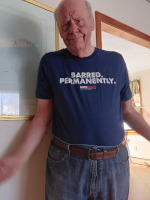
Mr. Ramirez seems a tad irritated:

That's his commentary on this: America Will Never Be a Communist Country.
And if you missed the initial brouhaha about the ad, the WSJ article from a few days ago will clarify: U.S. Government Airs Pro-Trump, Anti-Communism Ad. (WSJ gifted link)
On Wednesday night [September 23], a local CBS News reporter in Miami noticed something unusual during a Fox News commercial break: a punchy pro-Trump ad that said it was paid for by the U.S. government.
The ad begins with President Trump saying a frequent line he uses on the campaign trail: “Together we will defeat communism, Marxism in America once and for all.” The ad follows with dozens of images of the president at White House events. Playing in the background is a choir singing “Love Me.” Trump ends by saying “America will never be a communist country” and in small letters at the bottom of the screen it reads, “Paid for by the U.S. government.”
Creepy? Offensive? Out of the pages of 1984? See today's headline: it can be all those things. Not to mention "illegal". The WSJ story continues:
The administration’s decision to fund an advertisement that appears to include a voice clip from the Republican National Convention could violate federal law, ethics experts said.
“This is an astonishing misuse of public resources in the campaign context, one of the most blatant I’ve ever seen,” said Daniel Weiner, a former campaign finance official and senior director at the Brennan Center for Justice, which has been critical of Trump on ethics issues.
Unfortunately, anyone in a position to make the call on law violation is firmly in Trump's pocket. For example, FCC Chair Brendan Carr is more interested in going after journalists.
Coincidentally, via Patterico's Pontifications:
White House's Palm Room doors now lined with photos of Trump standing alongside Putin & Xi: pic.twitter.com/VgIuyxAgZY
— Jacqueline Alemany (@JaxAlemany) October 1, 2026
So we're kinda getting a mixed message from the Executive Branch about Commies.
Also of note:
-
"Look, Dave, I can see you're really upset about this." Sorry, that's what sprung to my mind while reading Anil Seth's essay, The Mythology Of Conscious AI. He's pretty convincing that "intelligence" is, at bottom, a tool for doing stuff. While "consciousness" is a different kettle of fish:
The propensity to bundle intelligence and consciousness together can be traced to three baked-in psychological biases.
The first is anthropocentrism. This is the tendency to see things through the lens of being human: to take the human example as definitional, rather than as one example of how different properties might come together.
The second is human exceptionalism: our unfortunate habit of putting the human species at the top of every pile, and sometimes in a different pile altogether (perhaps closer to angels and Gods than to other animals, as in the medieval Scala naturae). And the third is anthropomorphism. This is the tendency to project humanlike qualities onto nonhuman things based on what may be only superficial similarities.
I may be wrong, but I think of consciousness (and its cousin, free will) as "emergent properties": functionality that develops (via evolution, for you God-evaders) out of interactions of sufficiently complex nervous systems that are not themselves conscious.
And I've recently thought there's nothing to stop a sufficiently complex computing system from developing the same way.
But (on the other hand) there may not be any reason to expect that a computing system's "emergent properties" would look anything like human consciousness. We humans might not even be able to recognize it, let alone predict its behavior.
Well, sorry, that's for you college sophomores to discuss in your dorm rooms.
-
Free Luigi (with the purchase of another Luigi of equal or greater value). Jonathan Turley notes some disturbing attitudes down at Harvard Med School. “Free Luigi”: Rutgers Professor Calls for the Liberation of Accused Murderer Mangione.
Roxane Gay is the Gloria Steinem Endowed Chair in Media, Culture, and Feminist Studies at Rutgers University–New Brunswick. She currently serves as the artist-in-residence at Harvard Medical School and called this week for the “liberation” of accused assassin Luigi Mangione. Gay (the cousin of former Harvard University President Claudine Gay) is the latest example of the radical chic of higher education.
Professor Gay was on a panel on “fat liberation” at Harvard Medical School. In a video posted to X, Gay responds to a question about the health industry by declaring “Free Luigi, for one.” She added that “The health insurance industry is equal opportunity evil. They are terrible for thin people, for fat people, for white people, for black people … They just want to prioritize profit over bodies and health.”
It appears that it is not evil to murder UnitedHealthcare CEO Brian Thompson in December 2024, leaving a widow and children without a husband and father
Roxane was one of the prime panic-inducers cited by author Adam Szetela in his book That Book Is Dangerous!: How Moral Panic, Social Media, and the Culture Wars Are Remaking Publishing, which I reported on over at the book blog a few days ago. She's an enthusiastic culture warrior, apparently much tougher on authors that offend her than she is on cold-blooded murderers.
-
Also college administrators. Jeffrey A. Singer discusses some nanny-statism: Smoking Is Bad for You. Nicotine Isn't—but Politicians Keep Trying To Ban It.
Easthampton just became the 25th Massachusetts municipality to adopt a "nicotine-free generation" policy. Anyone born after January 1, 2006, will never be old enough to legally buy nicotine products there. The ban doesn't just apply to cigarettes. It also applies to noncombustible nicotine products that can help smokers reduce their risk.
Decades of anti-smoking campaigns have dramatically reduced cigarette use, especially among young people. That's great news. But somehow along the way nicotine itself became associated with the worst harms of smoking, even though the chemical is not responsible for the cancers, the lung disease, or most of the cardiovascular disease caused by combustible tobacco. Worse, the pendulum has swung so far in the maximalist anti-nicotine direction that we risk criminalizing some of the most effective smoking-cessation alternatives.
As we've previously discussed, the University Near Here tossed nicotine in with tobacco products in its draconian prohibition policy. Read Jeffrey's article to find out how that's pointless and (worse) counterproductive.